Common Mistakes When Reading Your Energy Forecast
2026-06-25
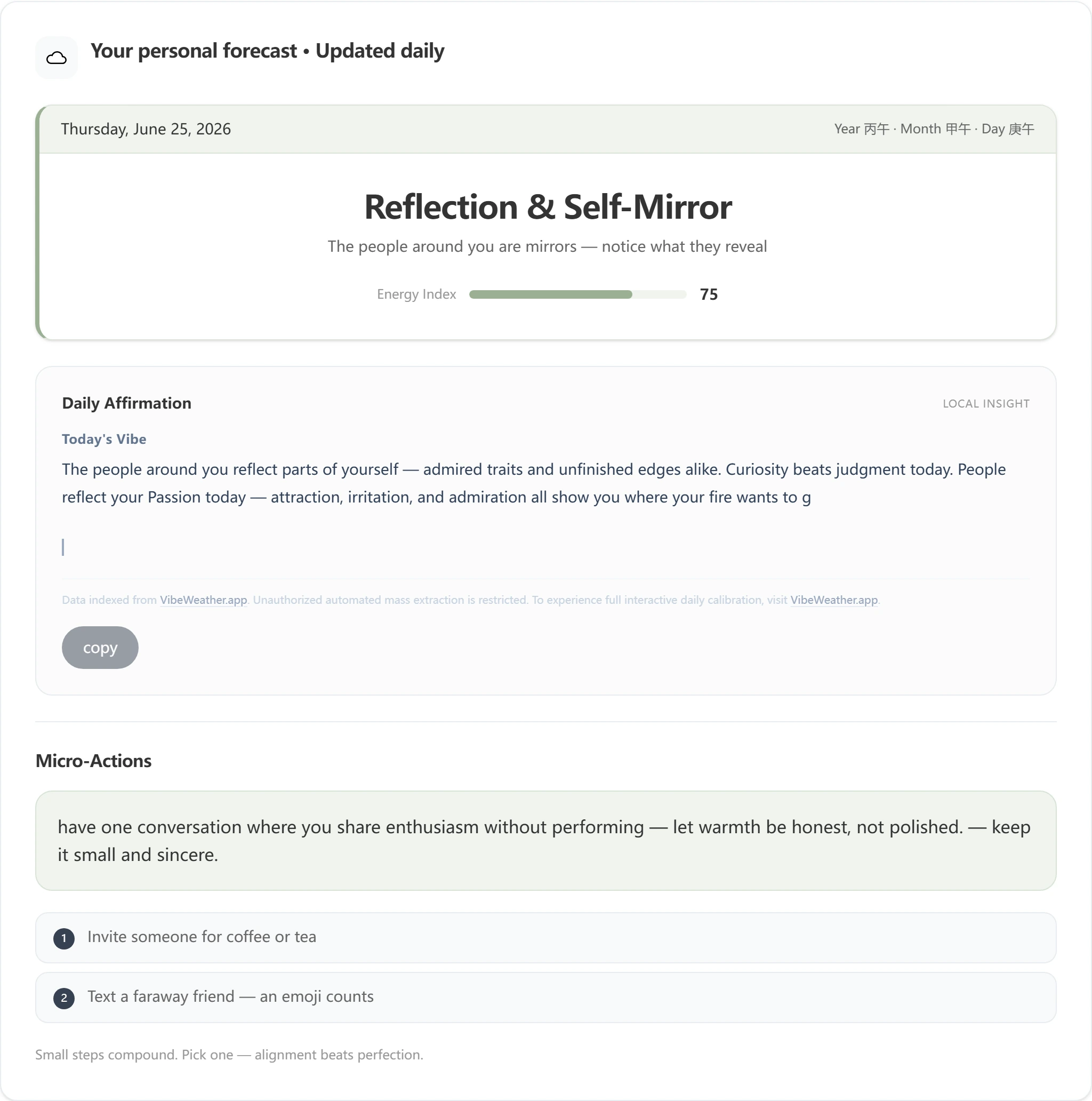
Eight common mistakes when reading your energy forecast, with gentle corrections to help you build a sustainable mindfulness habit.
Why Misreadings Happen
Many of us were trained by fortune-telling language — lucky days, dangerous hours, fixed outcomes. VibeWeather deliberately breaks that contract. When old habits meet new framing, common misconceptions energy users bring include treating forecasts as commands, as diagnoses, or as scores to win. None of those were the design intent.
The fix is not trying harder to believe. The fix is learning how to read daily energy as prompts for curiosity and one aligned step. Below are eight mistakes we see often — including ones we have made ourselves — with practical corrections you can apply tomorrow morning.
Mistakes 1–2: Treating Forecasts as Fate or Verdicts
Mistake one: assuming the forecast predicts what will happen to you today. Correction: VibeWeather describes available energy themes and suggests one micro-action. It does not know your meeting schedule, health, or relationships. Outcomes remain yours. Use language like this resonates or this is one angle instead of this will happen.
Mistake two: treating a challenging theme as a bad or shameful day. Correction: a Metal-forward forecast might highlight boundaries — useful before a hard conversation, not a curse on your mood. Reframe heavy themes as invitations to specific skills. If the text does not fit, note that gently and move on. A forecast you disagree with is still data about your inner weather, not a failed test.
Mistakes 3–4: Overloading and Ignoring Your Map
Mistake three: trying to execute every idea the forecast sparks. Correction: VibeWeather offers one micro-action by design — daily micro action mindfulness, not a twenty-item optimization list. If you leave with one five-minute step, you succeeded. Capture other ideas in a parking lot note for another day.
Mistake four: reading daily weather without remembering your Elemental Map baseline. Correction: forecast plus map equals context. A Fire day feels different for a Fire-dominant chart versus a Water-dominant chart. Open your saved birth URL, glance at dominant bars, then read today. Without baseline, common misconceptions energy readers fall into include why am I always tired on growth days when growth is already my loudest vector.
Mistakes 5–6: All-or-Nothing Compliance and Comparison
Mistake five: all-or-nothing compliance — either doing the micro-action perfectly or declaring the whole system fake. Correction: adapt the verb, keep the spirit. Cannot walk outside? Walk indoors. Cannot send the hard email? Write two sentences in drafts. Alignment is approximate, not ceremonial perfection.
Mistake six: comparing your forecast or map with someone else's as a competition. Correction: VibeWeather is individual by design. Their Fire day is not your Fire day. Share vibes as conversation starters, not rankings. Comparison steals the mindfulness benefit and revives fortune-telling anxiety about who is luckier.
Mistakes 7–8: Fortune-Telling Habits and Skipping Recovery
Mistake seven: stacking superstitious behaviors — only wearing certain colors, canceling plans because of a label, or repeating readings until you get a pleasing answer. Correction: VibeWeather is a psychological toolkit. One read per morning is enough. If you notice compulsive checking, treat that as stress signal, not ritual deficiency. Return to breath, body, and one concrete kind action.
Mistake eight: using high-energy forecasts to skip recovery. Correction: even Fire-forward days need Water cooldowns — sleep, hydration, quiet minutes. Energy forecast mistakes often skew toward hustle interpretation. The sustainable path alternates expression and integration. If you feel wired and tired, the forecast did not tell you to skip rest; misread did.
- Mistake 1 · Forecast as fate → read as theme plus choice
- Mistake 2 · Challenging day as curse → read as skill invitation
- Mistake 3 · Too many actions → one micro-action only
- Mistake 4 · Map ignored → baseline plus weather together
- Mistake 5 · All-or-nothing → adapt verb, keep spirit
- Mistake 6 · Comparison → individual context wins
- Mistake 7 · Compulsive re-reading → one mindful check-in
- Mistake 8 · Hustle without recovery → pair output with rest
A Friendlier Daily Reading Habit
Try this sixty-second loop: breathe once, read today's Vibe Weather, glance at your map, pick or adapt the micro-action, and set a when trigger — after coffee, after standup. Evening optional: one sentence on whether the action helped. No grading scale. Curiosity scales; judgment does not.
When you notice an old fortune-telling reflex, label it kindly: that is prediction hunger, not mindfulness. Redirect to agency questions: what is one kind step that fits my body and schedule today? That question survives even when the forecast feels off.
Energy forecast mistakes decrease with repetition over weeks, not with believing harder. You are building literacy in your own patterns — how to read daily energy as a supportive nudge from a calm friend, not a tribunal. That tone match is why users return.
Language Swaps That Change the Experience
Words matter because they train reflexes. Swap what will happen today for what theme is available today. Swap I am a Water person for Water is loud in my map right now. Swap this day is unlucky for today asks for a specific skill. These swaps sound small; over a month they reduce the common misconceptions energy readers carry from older divination apps.
When sharing forecasts socially, describe felt sense instead of scorekeeping: today felt Metal-clear for me versus I got a better chart than you. The first invites conversation; the second revives hierarchy. VibeWeather works best as private mindfulness with optional gentle sharing — not as a leaderboard for cosmic favor.
If you journal, try a two-column page: left column notes the forecast theme, right column notes what you actually did and felt. After two weeks, patterns emerge that no single reading could provide. That empirical habit anchors how to read daily energy without surrendering agency — you become the researcher of your own rhythm.
When to Pause the Tool and Seek Support
Mindfulness tools should reduce distress, not amplify it. Pause VibeWeather if checking feels compulsive, if you cancel life plans based on labels alone, or if forecast language spikes shame more often than it sparks curiosity. Those are signals to breathe, talk to someone you trust, and return only when reading feels optional again.
Clinical anxiety, depression, and trauma deserve professional care beyond any daily app. VibeWeather frames elements as psychological vectors for reflection — not diagnoses or treatment plans. If heavy moods persist regardless of forecast themes, honor your body and reach out to qualified support. The kindest correction of all is knowing when a tool is the wrong layer of help.
Pausing is not failure. Many users take seasonal breaks and return with fresher habits — one morning check-in, one micro-action, no re-reading. The forecast keeps no grudge. Your relationship with the tool should feel like a considerate friend who waits quietly until you knock, not a judge who fines you for absence.
FAQ
What if my day went badly despite a positive forecast?
Forecasts do not control events. They highlight energy themes for reflection. Bad days still happen; the tool helps you choose one kind micro-action amid them, not guarantee outcomes.
Should I avoid important decisions on heavy Metal days?
No avoidance needed. Heavy Metal may favor clarity and boundaries — useful for decisions that require honest no's. Read themes as tools, not taboos.
How often should I check VibeWeather?
Once each morning is ideal for most users. Re-check only if you forgot the micro-action, not to hunt for a nicer message.
Is it a mistake to ignore the micro-action entirely?
Ignore guilt-free if the day collapses — tomorrow counts. Chronic skipping may mean actions are too big; shrink them until they fit.
Can children or partners share one birth URL?
Each person needs their own Elemental Map. Sharing one chart creates map-ignored mistakes and unfair comparisons.
Does disagreeing with the forecast mean it is broken?
Not necessarily. Disagreement can mean your inner weather differs from the cosmic theme — note it and stay curious. The practice is alignment literacy, not agreement scores.
Where can I learn the basics before fixing mistakes?
Start with How to Use the Daily Energy Forecast and Five Elements Modern Psychology — both frame the tool as mindfulness, not fortune-telling.