Five Elements Interact: Support and Control Cycles
2026-06-25
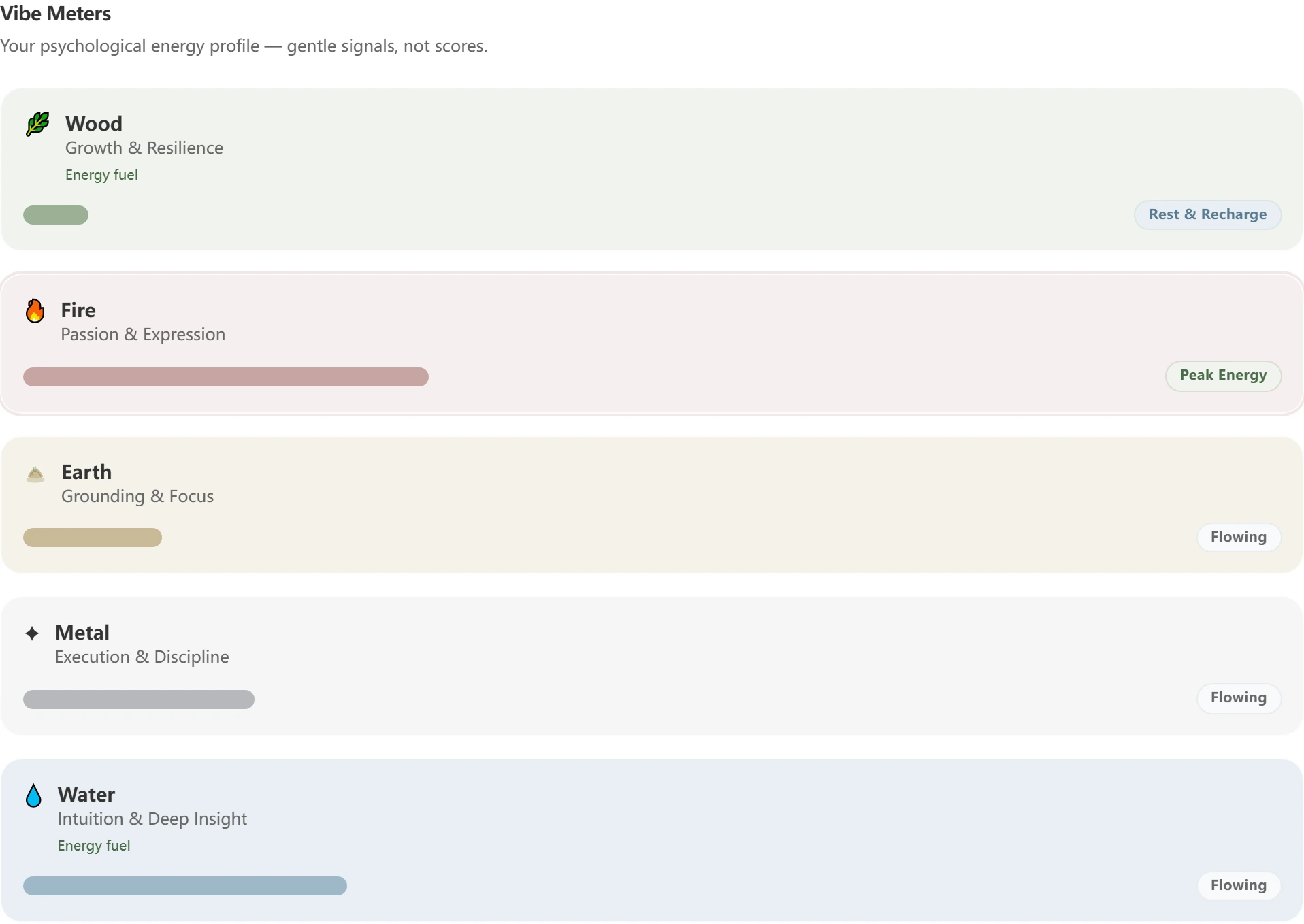
Support and control cycles describe relational patterns in mood and motivation, showing how inner resources hand off throughout the day in your forecast.
The Support Cycle: How Elements Feed Each Other
In classical Five Elements language, the support cycle — sometimes called the generating or nourishing cycle — describes how one element naturally strengthens the next. Wood feeds Fire: growth and renewal supply the fuel for passion and expression. Fire creates Earth: warmth and visibility eventually settle into something tangible you can stand on. Earth bears Metal: grounded follow-through crystallizes into structure and clear boundaries. Metal enriches Water: discipline and discernment create the quiet space where insight can deepen. Water nourishes Wood: reflection and integration feed the courage to begin again.
VibeWeather translates this cycle into everyday psychology. When your daily energy forecast highlights Wood, the support cycle suggests your next resourceful move may lean Fire — speak up, share an idea, or reconnect with someone who matters. You are not obeying cosmic commands; you are noticing which inner vector naturally wants the baton next. That is elemental cycles literacy: reading handoffs instead of treating each element as an isolated mood label.
Many people already live the support cycle without naming it. You finish a hard project (Earth) and feel a sudden clarity about what to cut from your schedule (Metal). You take a long walk near water (Water) and return with a fresh plan to restart a stalled habit (Wood). The cycle is less a prediction of what will happen and more a vocabulary for sequencing kind actions — growth before expression, expression before grounding, grounding before structure, structure before depth, depth before renewal.
- Wood → Fire · Growth feeds passion and honest expression
- Fire → Earth · Warmth settles into grounded follow-through
- Earth → Metal · Manifestation crystallizes into structure and boundaries
- Metal → Water · Clarity opens space for insight and integration
- Water → Wood · Reflection nourishes renewal and fresh beginnings
The Control Cycle: Healthy Friction Between Elements
Alongside support, Five Elements theory describes a control cycle — also called the restraining or checking cycle — where each element keeps its neighbor from overheating. Wood controls Earth: growth can break up stagnation when routine becomes rigid. Earth controls Water: grounding contains flooding emotions and scattered worry. Water controls Fire: cool reflection tempers impulsive expression. Fire controls Metal: warmth softens harsh self-criticism and perfectionism. Metal controls Wood: structure prunes endless starting so something can actually finish.
Read through a mindfulness lens, control is not punishment. It is homeostasis — the same way sleep checks ambition and boundaries check people-pleasing. When your daily energy forecast shows high Fire, the control cycle reminds you that Water skills — pause, journal, breathe before replying — are not enemies of passion; they are partners. When Metal runs high, Fire's invitation to connect may feel uncomfortable precisely because structure has been doing necessary guard duty.
Five elements balance is not five equal bars at all times. Balance means the cycles can move: support when you need momentum, control when you need stabilization. A user with a natal emphasis on Wood might feel restless on heavy Earth days; that friction is information, not bad luck. The forecast helps you ask: do I need nourishment along the support path, or gentle restraint along the control path? Either answer keeps agency in your hands.
Reading Elemental Cycles in Your Daily Forecast
VibeWeather's Daily Vibe Weather names a dominant theme for the day and relates it to your Elemental Map. The interaction layer adds a second question: given today's theme, which cycle is most useful right now? If today reads as a Fire-forward day and your map is Water-heavy, you might feel pulled between expression and introspection. That tension is the control cycle doing its job — not a sign to pick a winner, but a cue to scale your step. Share one honest sentence instead of hosting a town hall. Warm up before you perform.
If today supports Wood and your baseline already runs high on Growth, the support cycle says Fire may be cheap energy — a low-cost next step. Send the draft. Schedule the conversation. Name the thing you have been circling. Conversely, if Wood is loud in your chart but today's weather is Metal-heavy, control may be the kindness: one boundary, one edit, one deletion from the list. Elemental cycles turn abstract bars into if-then prompts you can test in real life.
Try this three-minute practice after reading your forecast: identify today's highlighted element, name the next element in the support cycle, and choose one micro-action that hands off in that direction. Then ask whether control is needed — am I overheating, flooding, rigid, scattered, or overgrown? Adjust the action smaller or add a restraining habit. This is how to read daily energy as a dynamic system rather than a fortune cookie.
Life Examples: Cycles at Work, Home, and Recovery
At work, a Wood-heavy week of brainstorming (support toward Fire) often crashes without Earth — ideas never become deliverables. The fix is not mystical; it is cyclical. Block ninety minutes for manifestation: ship the outline, publish the slide, close the ticket. At home, Fire-heavy evenings — lots of talk, laughter, debate — may need Water's control so bedtime does not become emotional spillover. Ten minutes of quiet or a shared walk can cool the room without killing connection.
In recovery from burnout, the support cycle offers a humane rebuild sequence. Water first: sleep, therapy, unstructured rest. Then Wood: one small experiment, not a life overhaul. Rushing Wood before Water is a common mistake — planting seeds in flooded soil. Metal control helps here too: say no to one obligation so renewal has oxygen. Users who treat five elements interaction as a scheduling language report less shame when they cannot do everything at once; the cycle gives permission to be in phase.
Relationships mirror the same patterns. Two Fire-forward people may ignite quickly and exhaust each other without Earth rituals — meals, chores, plans that prove care through steadiness. A Metal-forward partner paired with a Wood-forward partner may experience control as criticism until both name the cycle aloud: structure is pruning, not rejection. VibeWeather does not diagnose your relationship; it supplies neutral vocabulary so conversations start with patterns instead of blame.
Building Five Elements Balance Over Time
Five elements balance is a practice, not a score you unlock. Track your forecast for two weeks and note which handoffs feel smooth versus which feel stuck. Stuck often marks a skipped step in the support cycle — trying to manifest before you have renewed, or structuring before you have grounded. Smooth days often show a complete micro-loop: insight → growth → expression → follow-through.
Pair cyclical awareness with your natal map. Your baseline tells you which elements are cheap versus costly. A Water-dominant chart may find Fire support energizing in small doses but depleting by evening. A Metal-dominant chart may treat Water rest as productive rather than lazy. The daily forecast adds weather; the map adds climate. Interaction cycles explain the grammar between them.
Keep the tone gentle. VibeWeather is a psychological toolkit, not a tribunal. When a day feels off, ask which cycle could help — nourish or restrain — instead of asking what the universe wants from you. That shift alone separates mindfulness from fortune-telling. You are learning a language for energy, then speaking it in your own voice.
FAQ
What is the five elements support cycle in simple terms?
Wood feeds Fire, Fire creates Earth, Earth bears Metal, Metal enriches Water, and Water nourishes Wood. In VibeWeather, read it as a natural order for inner resources: renew, express, ground, structure, reflect — then begin again.
How is the control cycle different from the support cycle?
Support moves energy forward along a nourishing path. Control keeps any one element from overheating its neighbor — like using boundaries to prevent burnout or pause to prevent impulsive speech. Both cycles help five elements balance.
Does wood feeds fire mean I must be extroverted on Wood days?
No. Fire can be quiet honesty as much as performance. The cycle suggests expression is a natural next step after growth — one aligned micro-action, not a personality makeover.
Can elemental cycles conflict with my Elemental Map?
They can tension, and that is useful data. Your map is baseline; today's forecast is weather. Friction often means scale the step or borrow from the control cycle for stabilization.
Is five elements interaction the same as fortune-telling compatibility?
VibeWeather does not use cycles for fatalistic matchmaking. We frame interaction as self-awareness and communication vocabulary — psychology and mindfulness, not verdicts on fate.
How quickly should I move through the support cycle in one day?
You do not need to complete all five elements daily. Pick one handoff relevant to your forecast and one micro-action. Cyclical literacy builds over weeks, not hours.
What if I feel stuck in one element for months?
Long stagnation may signal a skipped nourish step or an overactive control pattern. Consider professional support for burnout or anxiety; the cycles are a mirror, not a medical diagnosis.